
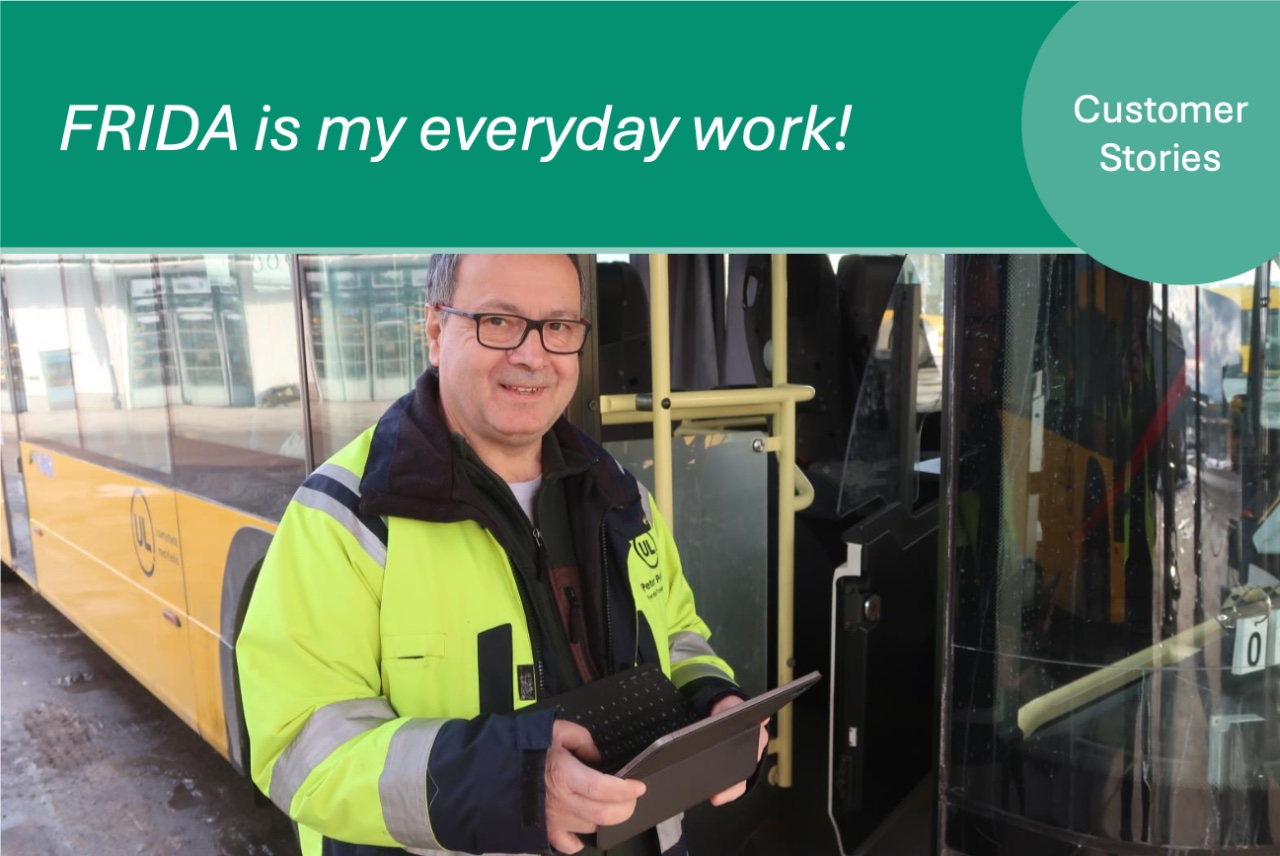
Having full control of all vehicles operating within Region Uppsala’s public transport system is both extensive and critical. The person with practical responsibility for this is Peter Peltekis – supported by FRIDA, public transport’s digital collaboration platform.
Peter Peltekis has worked in Swedish public transport since 1988. He began as a vehicle mechanic at Storstockholms Lokaltrafik (SL) and later served as Workshop Manager at Swebus in Märsta. He was then commissioned by Volvo to establish a bus workshop in Uppsala at Wist Last & Buss. In 2011, he became Vehicle Manager at UL, Region Uppsala.
What does your role as Vehicle Manager involve?
– A large part of my work is contract follow-up. I draft and monitor the vehicle appendices in our contracts and stay in close contact with Public Transport Operators and bus suppliers. It involves vehicle procurement and replacements. I am also responsible for FRIDA within the administration.
You also work with vehicle inspections – why is that important?
– Inspections are an important part of the contract with a Public Transport Operator. Both we as the contracting authority and the operator gain visibility into the quality of the vehicles we have procured.
The vehicles must meet UL’s requirements. Any deviations are discussed with the operator and corrective actions are agreed.
– We maintain a close dialogue with our partners under each Public Transport Contract– and FRIDA brings us together.
In total, 560 vehicles operate on behalf of UL across regional services, city services in Uppsala, city services in Enköping and school transport– all managed through FRIDA. Currently, three major operators hold contracts in Region Uppsala: Gamla Uppsala Buss (GUB), Keolis Sverige AB and Mohlins Bussar AB.
In November 2026, a further 13 contracts will be added to FRIDA, including taxi operators. This makes integration with systems such as the traffic management system Alfa particularly important. Implementation is already underway.
How does FRIDA support you in your daily work?
– Very much– FRIDA is my everyday work. It is what brings everything together.
Previously, we worked with paper and pen. When we wanted to further develop our vehicle inspections, FRIDA was introduced as a new digital tool. Since then, it has been essential in our operations.

When, where and how are vehicle inspections
carried out?
– We conduct targeted inspections, for example checking tyres that must meet specific winter requirements. We perform delivery inspections when new vehicles enter a contract. We also carry out spot checks when needed, as well as regular depot inspections where I visit unannounced to review vehicles.
What does the process look like before and after an inspection?
– At the start of a contract, we create an inspection protocol in FRIDA together with the operator. We review all contractual control points and determine, point by point, whether the vehicle is approved.
What happens if something is not as it should be?
– Then the vehicle is not approved. An automatic email is sent to the responsible persons at the operator, stating which points failed. The full inspection protocol is attached as a PDF, including photographs.
Regardless of whether the deviation concerns safety or mandatory contractual requirements, the operator must rectify the issue before the vehicle returns to service.
How would this work without FRIDA?
– Without FRIDA, it would be chaos. It is extremely difficult to manage inspections manually without a central database where all vehicles are registered. In FRIDA, we have vehicle inspections, the vehicle module, the environmental module and traffic incident reports. We also use a financial module to communicate and exchange documentation with operators.
A new version of FRIDA is on its way and will be available by mid-year.
– I am very curious about the new version. A range of new features are coming, especially real-time functionality. I will be able to see whether a vehicle has passed inspection and holds a valid traffic permit – directly in real time. It will be exciting to start using it.
You spend a lot of time in the field – how does communication with operators work?
– Very well. FRIDA includes functions that simplify communication, such as comment threads, email notifications and follow-up meetings. In many cases, FRIDA does much of the work automatically.
What do the operators think about being inspected?
– They think it is perfectly fine. I have never heard anything else.
– I receive very positive feedback from drivers. They appreciate that we inspect the vehicles and want everything to be safe and functioning properly. I have never experienced criticism from the operators.
Who else at UL uses FRIDA – and for what purpose?
– Our safety managers use FRIDA to review traffic incident reports. The financial module is used for monthly reporting exchanged with operators. I use the vehicle inspection and vehicle modules, while the environmental module is used by our Environmental Strategist. Our statisticians also use FRIDA to compile and analyse fleet data over time.