
The Right Vehicle in Service Is the Foundation of Trust and the Future of Public Transport
Public transport is a fundamental societal function. It must be accessible, safe and sustainable, and it must deliver on the goals defined politically and communicated to citizens. However, passengers do not encounter the contract, the governance model or the procurement documents. They encounter the vehicle in service.
Although operations are carried out by operators, it is the contracting authority’s brand and responsibility that are visible in every departure. The vehicle therefore becomes the most tangible manifestation of the assignment. It is where requirements regarding accessibility, capacity, environmental performance, safety and comfort must be realized in practice.
When the right vehicle is used in the right service, trust in public transport and in the responsible organization is strengthened. When the wrong vehicle is used, the impact goes beyond a single departure. It affects goal achievement, financial incentives, contractual relationships and ultimately the legitimacy of the entire delivery model.
Fleet Compliance provides the contracting authority with structured and continuous insight into whether the operator’s vehicle fleet complies with contractual requirements and ensures that only approved vehicles are used in service. The solution creates a systematic foundation for turning political ambitions into actual delivery, every day and in every assignment.
From Ambition to Verifiable Compliance
Clear vehicle requirements in a transport contract are a prerequisite for quality. Ensuring that those requirements are consistently met over time is a far greater challenge. In a contract portfolio with multiple operators, different service areas and extensive vehicle fleets, manual checks or occasional follow-ups are not sufficient.
FRIDA Fleet Compliance connects three central perspectives:
• the vehicle requirements defined in the contract
• the service planning that specifies which vehicle type is to be used for a particular assignment
• the real-time information showing which vehicle is actually in operation
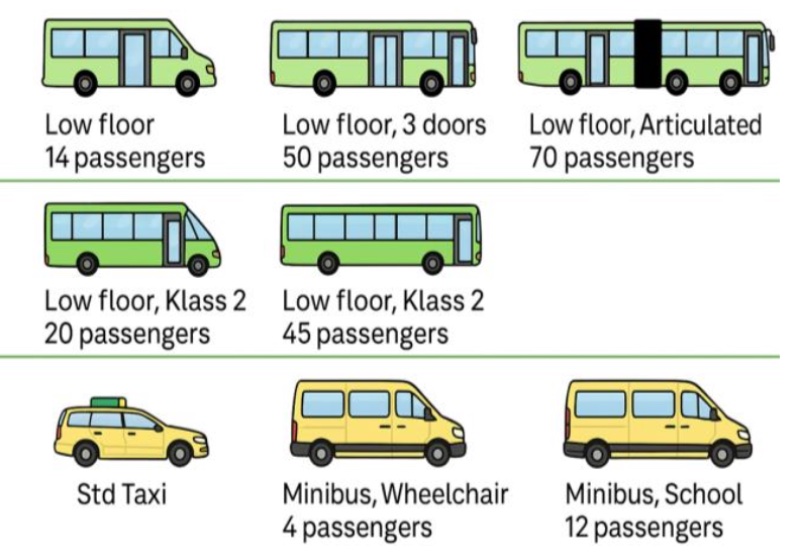

Through a clear and consistent structure for vehicle categories, capacity and characteristics, an unambiguous model is established defining what is approved under each contract. When this model is linked to planned and delivered services, FRIDA Fleet Compliance enables continuous and automated validation. It becomes possible to consistently ensure that the right vehicle is connected to the right contract and the right service assignment.
Compliance is therefore no longer an administrative check carried out after the fact. It becomes verifiable, measurable and possible to monitor systematically over time. Deviations can be identified close to when they occur and handled in a structured manner, reducing the risk of late discoveries and unclear responsibilities.
Transparency, Shared Situational Awareness and Controlled Flexibility
Professional service governance requires that all parties operate from the same information. FRIDA Fleet Compliance establishes a shared and transparent overview of the vehicle fleet, where contractual requirements, quality-assured vehicle data, current status and historical records are brought together in a unified structure.
The result is a clear and traceable classification of vehicles. It becomes evident which vehicles are fully approved, which have identified deviations and which are subject to review or corrective action. The information is consistent across the entire contract portfolio and less dependent on manual assessments or individual knowledge.
This shared situational awareness creates better conditions for dialogue between the contracting authority and the operator. Performance monitoring is based on a common data foundation, reducing the risk of interpretation disputes and enabling a more objective and constructive handling of deviations.
FRIDA Fleet Compliance also supports structured and documented exemption management. If a vehicle temporarily does not meet all requirements, the operator can apply for an exemption with a clear justification and defined validity period. Decisions are made on documented grounds, and every step in the process is traceable. This creates a balance between consistent enforcement of requirements and the flexibility sometimes needed in operational service delivery.
A Central Building Block in Public Transport Supplier Management
FRIDA Fleet Compliance is a central building block in a modern structure for Public Transport Supplier Management, PTSM. By connecting contractual requirements, vehicle data, planning systems and real-time monitoring, a coherent governance chain is established from contract to actual service delivery.
Contract requirements are structured within the system and directly linked to the services that are planned and operated. By using data from vehicle registers, inspection data and planning systems, FRIDA Fleet Compliance enables continuous and automated control of every vehicle put into service.
This means that the contracting authority can continuously ensure that a vehicle is approved for the relevant contract, that it meets defined requirements and that any deviations are identified and properly managed. Exemptions are clearly linked to decisions and validity periods, strengthening legal certainty in the follow-up process.
Through this structured connection between requirements and actual delivery, the contracting authority’s ability to govern the entire contract portfolio is strengthened in a consistent and transparent manner, regardless of scale or complexity.