
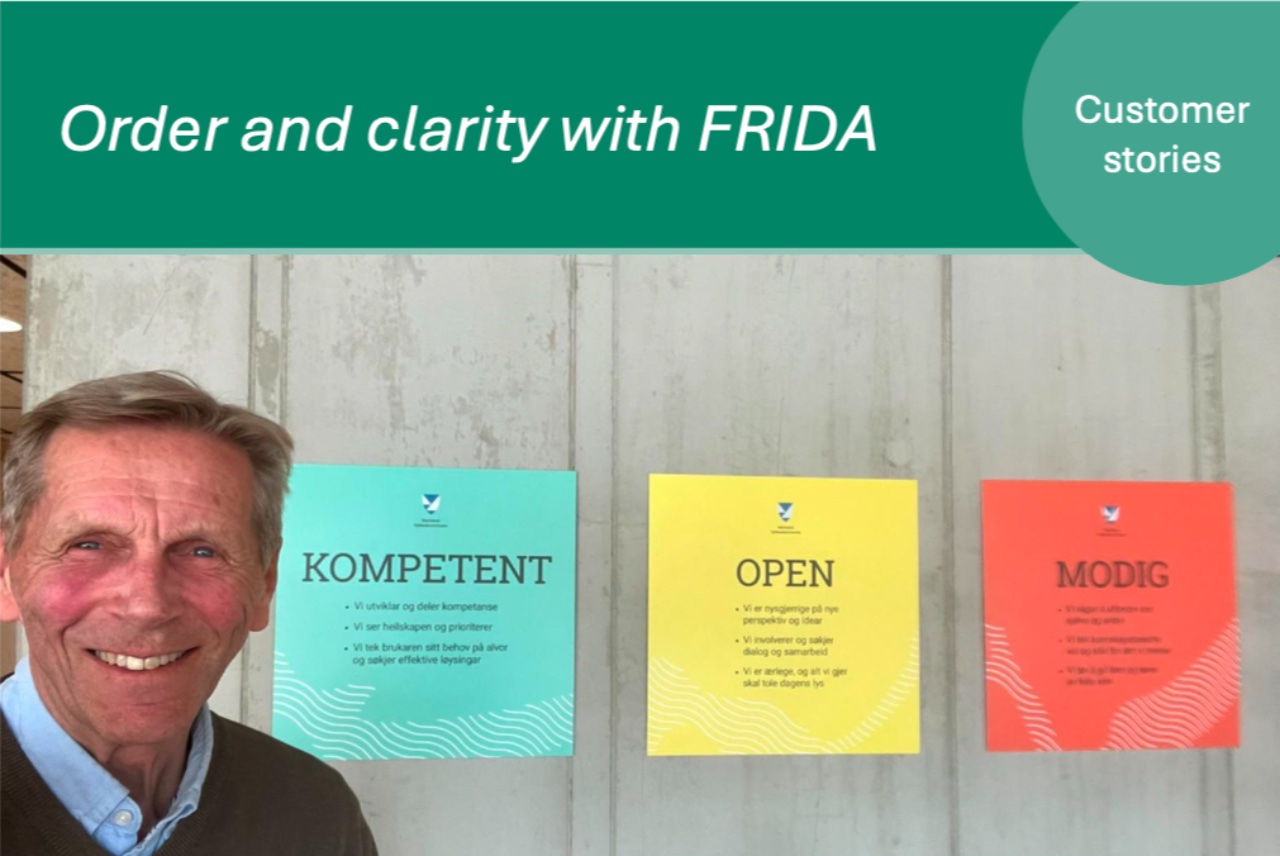
Skyss and FRIDA – Social Responsibility Monitoring
Vestland county in Norway doubled in size when three counties merged in 2020. A challenge for public transport, which publicly owned Skyss manages with the support of FRIDA.
Skyss is responsible for all public transport throughout Vestland county– mainly buses, but also ferries and boats. A key person there is Olav Lydvo, senior adviser.
When did you join Skyss?
– I started at Skyss in 2009. Since Skyss was founded in 2008, I joined just after the start and have been there for 17 years, says Olav Lydvo. We started using FRIDA in 2015 at Skyss, and it has since been a natural working tool in our daily operations.
What do you manage with the reporting module in those operations?
– I use the reporting module to manage 11 bus contracts, 3 ferry contracts and 6 boat contracts– 20 contracts in total. We have now been using the reporting module for nearly three years.
How did you manage before you had this tool?
– We had many difficulties. Documentation was missing– for example in bus transport, where contracts run for 13 years. Contracts just lay there, we had no system for updates, for instance no support for ISO certification that needed to be renewed.
Other things also needed renewing, such as national requirements that we were unable to capture at that time.
– There was also inconsistent handling of operators; it was largely up to the individual transport company how they carried out their assignment and reported back to us. With FRIDA, we could systematise all information from all our different service contracts. It was a great advantage that everyone was already familiar with FRIDA, so the introduction of the reporting module went very quickly and smoothly. We also achieved equal treatment of all operators regardless of contract type– we now had a comprehensive system for all parties.
You use the reporting module partly to monitor process requirements, both at contract initiation and on an ongoing basis. Can you describe what that looks like?
– There are many elements involved in that work. I monitor insurance terms, guarantees and joint liability, timetables, quality assurance systems, environmental certification, traffic management, press and media, deviations regarding punctuality and regularity, bus vehicles, material changes, documentation of wages and working hours, apprentice reports, ethical guidelines and certificates.
– It is a fairly wide range of topics handled with the tool regardless of transport mode, and it is done extremely efficiently.

Skyss also has a strong focus on monitoring social responsibility, and it is said you often call the reporting module the contract module – can you elaborate?
– Yes, social responsibility is of course important, and thanks to the reporting module that work can also be managed effectively. This too involves many elementsthat we handle with the tool.
These include statutory requirements, start-up measures, requirements for transfer of employees to a new contract and a new operator, wage requirements and working conditions, use of sub- operators, the obligation to monitor and provide information, audits and quality assurance, and the apprenticeship programme applied in Norway.
– Also important is what happens before a contract is established with a new operator – for example ensuring that bus drivers from the previous contract transfer to the new one. Likewise, that everything is settled regarding wages and working conditions, says Olav Lydvo.
Is there more to say about how process monitoring works in your day-to-day work?
– Yes, we hold contract meetings between Skyss and the relevant operator. We go through fixed agenda items, including how we view operational technical factors, delays and that type of thing – all of this we record in the reporting module.
– When needed, we also hold special meetings, for example on driver recruitment. And finally, we have internal meetings where we use the reporting module to go through current matters – among other things, we will run a new phase in autumn 2026 to monitor three new bus contracts starting in June.
What are the particular advantages of using FRIDA’s modules?
– It makes us more efficient at finding missing documentation, and we gain confidence in managing contracts correctly. We also avoid the guilty feeling of not keeping on top of everything we need to – that is a gain in itself from the reporting module.
– We also get a more secure and reliable basis for external auditing of operations, confirming that Skyss manages public funds by monitoring contracts correctly.
– Also worth noting is that FRIDA handles both the documentation the operator needs and the documentation that Skyss requests as contracting authority.
How do you see the near future for Skyss and continued use of the reporting module?
– Very positively! There is complete consensus within Skyss that this is how we want to work. It is important to focus on documentation, which is especially relevant now that we have three major contracts to manage in the near future. FRIDA also helps us create a good dialogue with operators through the modules we have access to. And here I want to highlight that the tool helps the smallest operators to build good internal documentation. FRIDA does not add extra work for smaller operators – quite the opposite, it has been very positive for them too.
Is there anything more you would like to raise regarding FRIDA and the modules you work with?
– For us it is valuable to have cross-contact with different operators and contracting authorities. We hold regular meetings twice a year – FRIDA user meetings where we can network with other contracting authorities, talk to each other, ask questions and get tips on how others have handled contracts and the reporting module.
– We also meet people from outside, which makes these meetings a genuine arena that adds real value to our overall work. All of this we can thank FRIDA for – we have gained increased knowledge, and so have all other FRIDA users.