
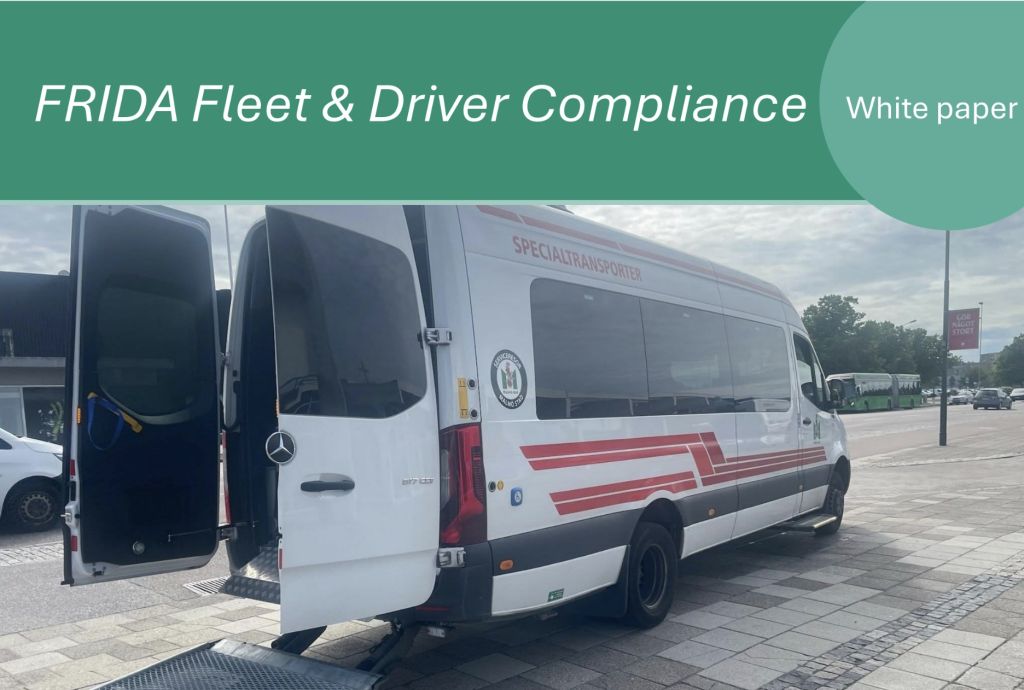
The right vehicle and driver for every assignment
Public transport depends on the right resources being used for the right assignment. In demand-responsive transport, vehicles and drivers are allocated to a booked trip. In regular public transport, buses and drivers are planned on blocks and duties. In both cases, the operator must ensure the resources meet both legal requirements and the contract terms.
It is therefore not enough for a vehicle or a driver to be available. The vehicle must be of the right type and approved for the service. The driver needs the right licence, the necessary permits and must meet the assignment’s requirements.
Through integration between FRIDA and booking and planning systems, the checks can be made before resources are allocated to services. Compliance monitoring thus moves from after-the-fact inspection to active support in planning.
Approved resources in every assignment
There may be vehicles and drivers in FRIDA’s registers that do not meet all requirements. What matters is that their status is clear and that they are not allocated to services until approved for the assignment.
FRIDA provides the booking or planning system with a quality-assured basis for decisions.
The information can be used to warn, stop an allocation or require that another resource is chosen. Responsibility for using only approved resources remains with whoever plans and operates the service.
If no approved resource exists, the shortfall shows up in planning and can be handled before services are affected.
The vehicle must be both right and approved
A vehicle being available does not automatically mean that it may or should be used. It must meet statutory conditions, fulfil the contract’s requirements and be of the right vehicle type.
If, for example, a booking concerns a stretcher transport, the allocated vehicle must be classified as a stretcher vehicle and meet the requirements for that vehicle type.
The same principle applies in regular public transport. When a bus is planned on a block, the operator’s system must be able to check that it is the right vehicle type and is approved for the service. The check should take place before the service starts, not when the PTA reviews operated services afterwards.
Vehicle types are part of FRIDA Fleet Compliance. Via the FleetComplianceAPI, FRIDA can tell connected systems the vehicle’s type and whether it meets applicable legal and contractual requirements. The system thus need not recreate or interpret all the requirements itself.

The vehicle fleet is managed once
The vehicle fleet can be synchronised from FRIDA to the booking or planning system. When a vehicle is added, changed or taken out of service, the information is handled in FRIDA and made available to connected systems.
This reduces duplicate administration and the risk of conflicting or outdated data. FRIDA becomes the quality-assured source for vehicles, vehicle types and compliance, while the connected system is responsible for planning and allocation.
The vehicle part of the integration is already used by customers with the booking systems Alfa from SnapCode and We from Trapeze.
Allocation and capacity are different questions
Checking an individual allocation needs to be separated from the question of whether the operator has enough resources.
Some contracts require a minimum number of approved vehicles of a certain type. This may be linked to capacity, standby or remuneration. It is an important part of contract monitoring, but a different check from the one deciding whether a given resource may be used in an assignment.
The same quality-assured information can support both needs.
FRIDA Drivers moves the check earlier
FRIDA Drivers* complements the vehicle check by gathering the information needed to assess whether a driver meets legal and contractual requirements.
The driver may, for example, need the right licence category, valid permits and other qualifications for the service in question.
In many operations, part of the check happens only when the driver logs in to the on-board computer, e.g. before a block or trip. Checks against external sources, such as BKY, can then be part of the flow.
With FRIDA Drivers, the driver’s compliance is available as soon as the driver is planned on a vehicle or transport assignment. Deviations can thus be detected before the trip is due to start
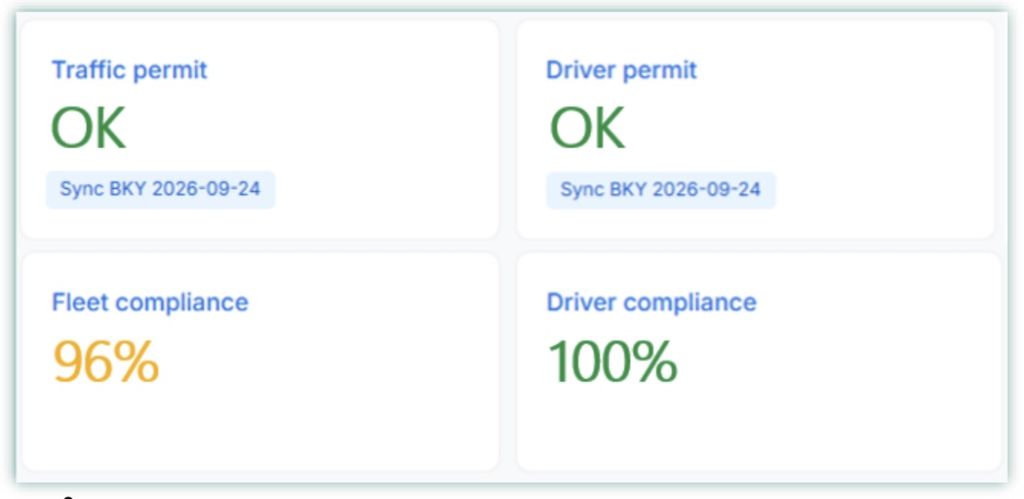
Via FRIDA’s API, the booking or planning system gets a clear answer: is the driver OK or NOT OK? Behind it lies an overall assessment of the driver’s qualifications, permits and contractual requirements.
Vehicles and drivers are checked as a whole
When Fleet Compliance and FRIDA Drivers are used together, the planning system can verify both the vehicle and the driver before allocation.
Already in planning, the operator can match an approved vehicle of the right type with an approved driver. If either fails the requirements, another can be chosen before services are affected.
The check thus becomes a natural part of service planning rather than an administrative review after the fact.
From contract to actual delivery
The integration between FRIDA and the booking and planning systems creates a clear chain of control from contract requirements to completed transport and is an important part of Public Transport Supplier Management, PTSM.
The PTA is better placed to monitor that services use approved resources. The operator can carry out the check as soon as the resources are planned. For the passenger, it means safer transport where both vehicle and driver have been verified before the assignment.
FRIDA Fleet Compliance and FRIDA Drivers enable systematic, automated and traceable quality assurance of every transport assignment.
* FRIDA Drivers – General Availability: Q4 2026.